Not be confused with Entophobia, the fear of ancient, walking talking tree people, entomophobia is the fear that insects will crawl into your ears, eyes, nose and mouth to eventually lay eggs on your brain. Contestants on Fear Factor have bunjee jumped off helicopters, but ask them to lie in a coffin filled with bugs and their courage crumbles. So why is it that we, the dominating species on the planet, capable of jumping out of airplanes, wrestling alligators, and rushing into burning buildings to rescue babies, are so utterly terrified of creatures hundreds of times smaller than us? The following are some of the most horrifying, agony-inducing, flesh-melting, downright dangerous insects known to man. 10 damned good reasons to be afraid…very afraid! Brazilian Wandering Spider
This little beauty is not only the world’s most venomous spider, according to the Guinness Book of World Records, but is also believed to be responsible for the most human deaths. These deadly arachnids got their name because, unlike most spiders, they don’t hang out in a web or a lair at night, but wander the jungle floor looking for prey—though these pests are increasingly found in cities. During the day Wandering Spiders hide in termite mounds, under logs or sometimes in banana plants. The venom these spiders produce is similar to the neurotoxin found in Black Widow Spiders, causing pain, cold sweats and an irregular heart beat. It’s believed that between the year 1970 and 1980 Brazilian Wandering Spiders were responsible for hospitalizing about 7,000 people in southern Brazil. If it doesn’t manage to kill you, however, there are some pretty embarrassing side effects that come with this spider bite.
Africanized Honey Bee (a.k.a. Killer Bees)
The world is full of dangerous things that can kill us, but we only have ourselves to blame for this one folks. Back in the day settlers in North and South America wanted a hardy bee that produced a lot of honey. Well, European bees were bigger and produced more honey, but they were kind of frail. African bees, though tough, were much smaller. So to get the best of both worlds, they bred these two bees together. This produced a race of large, very aggressive honey bees with a habit of absconding (or abandoning their hives to start new ones elsewhere). These bees are hyper-defensive and attack relentlessly in giant swarms when threatened.
If an Africanized honey bee stings you they not only release their venom, but they release a banana-scented pheromone which signals the other bees to attack. You can withstand approximately 7 stings for every pound you weigh before your life is in serious danger. These bees have been known to swarm and attack as far as ¼ mile from their hive, and can sting up to 500 times in 30 seconds. You do the math.
These bees used to dwell mostly in South America, but have been migrating further and further north in recent years. Giant Japanese Hornet (a.k.a Asian Hornet)
No, that picture isn’t Photoshopped. The bug is really that big. When these puppies aren’t picking fights with entire bee hives or eating honey bee larva, they can be found stinging annoying humans in the Tokyo region with their 6mm stingers (that’s about a quarter inch). Not only are these bugs frighteningly big, but they’re also frighteningly dangerous. Giant hornet venom is more potent than that of its smaller, puny relatives; it’s a mixture of acetylcholine—which causes a lot of pain—and an enzyme that’s capable of dissolving human flesh. People who have experienced being bitten by these bugs say it feels like a hot nail being driven through your flesh. And once you’ve pissed one of these guys off it will chase you for over three miles. Each year in Japan, Giant Hornets kill more people than all other venomous and non-venomous animals combined.
Siafu Ants
Found mostly in central and east Africa, these ants aren’t so tough on their own. Problem is, you’re not very likely to find one of these little guys by themselves. Siafu Ants live in giant colonies of about 20 million individuals.
When food gets low the ants set out in search of food in columns that can consist of as many as 50 million ants. And that’s when you don’t want to mess with them. The columns defend themselves viciously, and have a military structure complete with sentries that set up a perimeter corridor to protect the smaller members of the colony. You’re not in too much trouble as long as you can run away from a column, but if you’re sick or debilitated or just generally stuck in one place these ants can kill you and consume your entire body. Most people die of asphyxiation rather than the painful venomous bite. These ants have such powerful jaws that in East Africa, people used them to perform emergency sutures. Bullet Ant
So maybe swarms of tiny ants don’t scare you. How about this giant screaming mofo? That’s right, screaming. Bullet Ants hail from the low land rainforests of Nicaragua and Paraguay. Each ant is about an inch long and lives in a tree colony. When a predator approaches the colony some of these bad boys drop down onto it, letting out a shriek before they do. While not the deadliest insect, the Bullet Ant’s sting is said to be the most painful in the world, according to the Schmidt Sting Pain Index. The insect’s sting causes waves of burning, throbbing, mind-blowing, pain that doesn’t stop for 24 hours. It hurts so much it feels like you’ve been shot with a bullet (Get it? Bullet Ant?) Some South American societies use the Bullet Ant to test the manhood of young boys, making them endure 20 stings without crying out before they can be considered men. Some white people think that sounds cool and decide to do it just for kicks.
African Assassin Bug
This brightly-coloured bug is said to have venom 10 times more potent than a cobra, which it can either spit at or inject into its prey. One bug won’t kill a human, but get bit by enough and you’ll be in trouble. The Assassin Bug’s venom, rather than paralyzing its prey, will liquefy their insides. It uses its proboscis to suck the liquid insides from its prey or to bite unsuspecting human beings. The Assassin hunts by covering itself with the dead bodies of past meals. When an unsuspecting insect wanders by and thinks one of the empty bug husks looks tasty, the Assassin Bug dumps the decoys and pounces. Some brave—or crazy—humans have taken to keeping these bugs as pets because they can control most pest problems very efficiently. Other people keep them as pets so they can videotape them hunting, set it to whimsical music and post it all on YouTube.
Kissing bugs
These bugs aren’t really deadly because of their venom or because they’re particularly fearsome. Kissing bugs are dangerous because they infect human beings with Chaga’s disease. These insects don’t die after biting so it’s possible for them to bite multiple humans and pass the Chaga’s parasite along. The bugs hide inside houses and drops down onto people while they’re sleeping, biting the soft tissue of the lips and eyes. Chaga’s disease, however, is actually passed to a new host through the bug’s feces that enter the human body through the wounds it inflicts.
As of 2008, 16 to 18 million people were infected with the disease, with 20,000 dying of the affliction yearly. Chaga’s causes sever heart damage. Heart transplants for victims are ineffective because the parasite just ruins the new heart as well. Mosquito
Okay, so we’ve all seen Mosquitoes before and they’re not particularly terrifying. But their kill rate certainly should scare you. These blood suckers kill more people than all of the flying menaces and deadly spiders combined. Mosquitoes pass along diseases like yellow fever, denegue fever, Chikungunya, West Nile virus and the ever popular malaria. It’s estimated that in Africa alone mosquitos are responsible for infecting 700 million people with disease, killing 2 million in their infectious wake.
In simple terms, a virus can aptly be called a virtual disease which affects a computer system and makes it sick, forcing to act in a manner undesired by the user. No good deed goes unpunished, and with the joys and leisure that were brought by the computer, along came the viruses to ruin all the fun. There are billions of viruses out there, big and small. But there were some that stood out and ruined things for us in a spectacular fashion. Below is a list of 10 of the deadliest virus which create havoc in the virtual as well as the real world.
I love you
The three words that can at most motivate you to cross the seven seas - or at least tempt you to open en email. This very temptation was the downfall of many computer users when this multipurpose-multi skilled virus hit the web. It had the ability to replicate itself via IRC chat and email, transfer and hide itself in different files and folders, and infect the registry keys once you opened an email in you inbox declaring “I Love You”. The virus thought to be originated somewhere in the Philippines, caused damage which was estimated to be around $8-10 billion.
Melissa
The creator of this virus received a 20 month jail sentence and a $5000 fine. Generated over a decade ago, this clever piece of virtual disease operated through Microsoft Outlook. This is how it worked: you receive an email titled “Here is the Document you asked for” from an unknown sender, you got infected as soon as you opened the email, and the virus would replicate and delivers itself to the top 50 people on your list without you getting a hint of it. Some major US government departments were hit and the damage is thought to be around $1 billion at least. A 20 month jail sentence well deserved.
MyDoom
MyDoom was instigated somewhere in mid 2004 and it actually prompted US senator to propose the creation of a “National Virus Response Centre”. The virus attacked in two phases; the first phase infected different Operating Systems, creating inroads and backdoors and making them vulnerable to external users. Once this problem was sorted out, the MyDoom struck again after few months, this time targeting the Search Engines like Google, slowing them down considerably, and crashing a few.
Nimda
Spell it backwards and you will understand its prime targets: yes, the ‘Admin’ and servers. It was basically a worm and has the record of being the fastest ever virus to spread; it took only 22 minutes to break into the list of top ten most deadly viruses of all times. It basically targeted internet servers and websites, creating a mass crater through which thousands of computers were affected at the same time. Once infected, the systems became exposed to open attacks by the outsiders.
Code Red
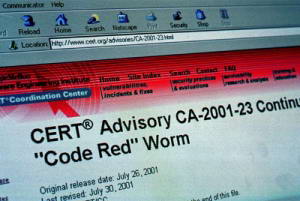
Damages of almost $200 million a day, and affecting the computers inside the White House are the degree of achievements of this virus. It subjugated the Windows by acting as a buffer overflow, sending humongous amount of information to the computer so that it spilt over, eventually forcing a shut down by overlapping the memory of the computers. The problem wasn’t solved until Microsoft issued a revival package to cater for this virus.
SQL Slammer/Saphire
Another swiftly spreading virus, it hit 75,000 computers in the first 10 minutes of its inception, taking down and severely damaging numerous American Banks, Security systems and organizations, and Airline networks. And the virus wasn’t just privy to the US; it ruthlessly damaged the internet capacity of South Korea for at least half a day. The damage was estimated around at least a billion dollars.
Storm Worm
One of the latest and most recent viruses to strike the internet, the Storm Worm employed a similar strategy to the one used by the Melissa; the mail’s title mentioned a current natural disaster like an earthquake (but most often a storm). Once the email was opened, the virus spread around like wild fire, affecting registries and documents across the hard disk. It turned out to be a mother-virus, instigating numerous hidden programs in the background which made the PC vulnerable and enticing to hackers.
Klez
With the mix characteristics of a virus, worm and a Trojan horse, Klez gave the antivirus programs a real headache by simply disabling them and making them look like a joke. However this is only the beginning of its trickery; after it was thought it be defeated, it was taken over, decoded and customized by black hat hackers (hackers who specialize in unauthorized penetration). Its ability was enhanced by providing it with the capability to "spoof" from the user's address book and make it look like that an email came from them, increasing the chances of the receiver opening the email and becoming the next casualty. Sasser
Damaging the computer through network ports, Sasser mostly targeted Windows 2000 and XP. It’s main casualties were the news agency Agence France-Presse (AFP) which had all its satellite communications jammed for hours , U.S. Airlines which had to reschedule its flights because of the worm had depleted their computers, a Finnish insurance company which was forced to close down 130 of its offices on emergency basis, Goldman Sachs, and Deutsche Post were all badly affected as well. However its unique feature was that it did not spread through emails, but rather observed computers and kept a look out for their vulnerabilities. On the basis of its knowledge, it would scan random IP addresses from the database and send itself to the next victim.
Autorun
This virus primarily targeted USBs and flash drives and established them as its major source of movement and propagation. It affected networks and all the computers present on them. Once affected, the folder options would be disabled, the task manager too would be unavailable and the virus itself would become the system administrator. The virus would replicate itself in all the folders, therefore eating up useful space on the hard disk and making it eventually extremely slow. The loss was in terms of useful data on millions of computers across the world.